Would an AC disconnect meet the requirements of this section? The lock is on the cover / door of the AC disconnect.
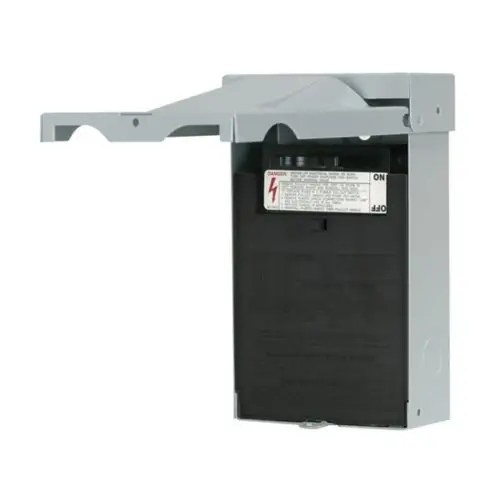
Section 625.43 requires that equipment which is rated more than 60 amperes or that is rated more than 150 volts to ground be provided with a disconnecting means in a readily accessible location. The last sentence of this section requires that the disconnecting means be lockable open in accordance with section 110.25. This last sentence is the primary focus of our discussion.
Because 110.25 is referenced, we have to review that language. This section requires that when a disconnecting means is required to be lockable open, such as that found in 625.43, it must be capable of being locked in the open position and the provisions for locking must remain in place with or without the lock installed.
Taking both the requirements of 625.43 and 110.25 under consideration, an argument has been made that simply locking the cover of a disconnect cannot meet the requirements of a disconnect being required to be lockable open. A pull-out switch, like that being identified here, would not directly have that capability because to open the disconnect you have to pull out a part of the switch itself.
The pull-out switch is listed to UL 1429, Standard for Pullout Switches. Under UL 1429 Section 1.2 establishes the maximum rating as:
-
Maximum ampere rating: 400 A
-
Maximum voltage rating: 600 V
-
Configurations: Fused or nonfused, with or without horsepower ratings.
Therefore, 400 A is the largest ampere rating permitted within the scope of UL 1429. That does not necessarily mean a manufacturer currently offers a UL 1429-listed 400 A pullout switch.
For an EV charging application, a 400 A switch could potentially be used, provided its listing, continuous-current limitations, short-circuit rating, and the applicable NEC disconnecting requirements are satisfied.
The question here is whether or not a pull-out switch can satisfy the requirement that it be locked in the open position.
Let’s consider the operating sequence:
-
The electrician opens the enclosure door.
-
The electrician removes the pull-out disconnect block, interrupting the circuit.
-
The electrician places the block in its OFF storage position.
-
The electrician closes the enclosure door and installs a padlock.
The fundamental question in this application is whether or not locking the enclosure door actually locks the disconnecting means in its open position or does it simply restrict access to the disconnecting means?
It is the opinion of this author that this scenario would NOT meet the requirements of 110.25 because the language of the electrical code states that the disconnecting means must be lockable in the open position. A pull-out switch only locks the cover and does not lock the disconnect itself.